Yiaga has been quietly finding its feet in Fitzroy Gardens over recent months, and its arrival marks an important moment for Melbourne’s fine-dining landscape. Led by chef Hugh Allen, the restaurant reflects a deliberate and personal approach to cooking, one grounded in place, produce and a clear point of view.
Rather than arriving with noise or spectacle, Yiaga has settled into service with calm confidence. It is a room built around craft, pacing and detail, designed to allow both the kitchen and the food to speak clearly.
A chef’s first signature venue
Hugh Allen is well known to Australian chefs for his technical grounding and years spent in some of the country’s most demanding kitchens. His career has been shaped by exposure to disciplined environments where standards are exacting and expectations are clear. With Yiaga, Allen steps into his first solo project, shaping a restaurant that reflects his own instincts rather than an inherited framework.
The setting is integral to the experience. Yiaga sits within Fitzroy Gardens, and the sense of transition as guests move through the grounds and into the dining room sets the tone for what follows. The room itself feels intentionally restrained. Clean lines, natural materials and framed garden views create an environment that encourages focus and calm.
A kitchen led by produce and clarity
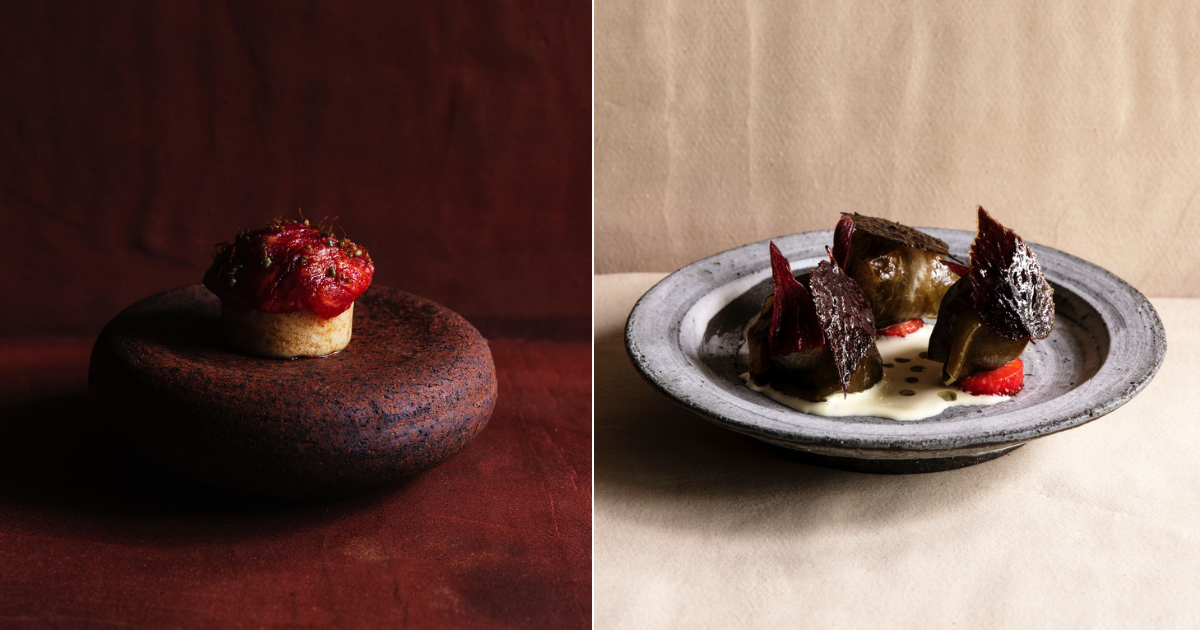
Yiaga’s cooking is grounded in Australian ingredients, with an emphasis on produce that reflects both season and place. Dishes are built around flavour, balance and texture, rather than ornament or excess. Menus evolve through measured refinements rather than constant reinvention, allowing the kitchen to focus on consistency and execution.
For chefs, this approach is telling. It speaks to a kitchen that values rhythm and repetition, where discipline and restraint support long-term sustainability rather than novelty for its own sake. The menu offers enough complexity to challenge the brigade, but not so much that service becomes brittle under pressure.
The rhythm of the room
The open kitchen forms the heart of Yiaga. Guests are seated within view of the brigade as dishes are finished and passed, creating a clear connection between kitchen and table. This transparency places a premium on organisation, communication and calm leadership.
Service moves at a deliberate pace. There is time to observe the kitchen at work, to understand how stations interact and how dishes come together. It is an environment that encourages concentration rather than haste, and one that rewards precision.
For cooks, this model highlights how smaller, tightly run brigades can deliver high-level dining without the scale or intensity traditionally associated with fine-dining rooms.
Craft shaped by design
The restaurant’s physical design plays a quiet but important role in shaping the experience. Nothing in the room competes for attention. Instead, the architecture supports the kitchen, framing the action rather than distracting from it.
This relationship between space and service reflects a growing movement in contemporary hospitality, where design is used not as spectacle but as a tool to support clarity, workflow and guest focus.
In Yiaga’s case, this restraint reinforces the kitchen’s philosophy. Each element of the room exists to serve the whole, creating a dining experience that feels cohesive rather than layered for effect.
What Yiaga represents for chefs
For chefs watching closely, Yiaga offers an important reference point. It demonstrates how a contemporary fine-dining restaurant can establish a strong identity without relying on constant change, excessive scale or theatrical presentation.
Instead, Yiaga positions itself around discipline, clarity and a steady hand on service. It shows how restraint can become a defining strength, and how a well-considered room can support both creative expression and operational sustainability.
It also reflects a broader shift in how chefs are choosing to define their own spaces. There is growing emphasis on building rooms that feel personal, measured and capable of sustaining quality over time.
As Yiaga continues to settle into its early rhythm, its significance will be measured less by hype and more by how clearly it maintains its voice. For many chefs, that clarity is what makes it worth paying attention to as Melbourne’s dining scene continues to evolve.





