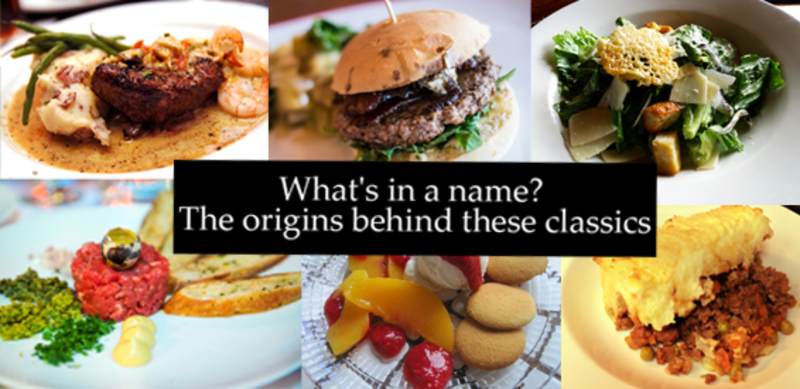
peach halves, vanilla ice cream, and a raspberry sauce, first appeared in the early 1900s. Auguste Escoiffer, a Frenchman working at the Ritz Hotel in London, named the dish after Australian Opera Singer, Dame Nellie Melba.

Melba frequently performed at the Covent Garden Opera House and often ate at Escoiffer’s restaurants. Allegedly, Melba sent Escoiffer tickets to her performance of “Lohengrin”, an opera featuring a boat in the shape of a swan. Taking inspiration from this, the next evening Escoiffer presented Melba with peaches and vanilla ice cream in a dish atop an ice swan, naming it “Pecheau Cygne” (peach with a swan). He later revised the dish, adding raspberry puree and renaming it after the singer, “Pêche Melba”. Melba toast was also named in the star’s honour by Escoiffer, he seems to have been quite the fan.
Sirloin of Beef

The origin of the “sirloin of beef” is quite straightforward. “Sirloin” is simply a derivation of the French word “surlonge” (“sur la longe”) meaning, above the loin of a cow.
However, the misconception is more interesting. The spelling of “sir” in sirloin rather than the French “sur” suggested some sort of prestige to the cut of beef.
There have been stories that the cut was enjoyed so much by royalty that it was knighted “Sir Loin of Beef”. This is completely untrue but almost bizarre enough to be believed.
Steak Tartare

It has been suggested that the origin of the name “steak tartare” goes back to the Mongolian and Turkic tribes, known as Tartars. They were thought to have placed their beef, or horsemeat, under their saddles so that the meat tenderised as they rode. While this does seem plausible, there appears to be no evidence to prove it. It has also been suggested that they never ate the meat, but used it for additional comfort while riding.
Another suggestion, is that it’s simply a shortening of “a la tartare” – served with tartar sauce. It has evolved over time, as many recipes do. This meat dish is now comprised of finely chopped or minced raw beef, with onions and capers, seasoned well, and often served with a raw egg yolk. The word “tartare” is now often used when meat or fish is raw when served.
Toad in the Hole

Batter puddings became popular at the beginning of the 18th century. Toad in the hole, with its sausages poking out of the batter, is likely named this due to the resemblance, albeit very slight, to toads peering out of crevices.
Another suggestion, although contested, is that a golf course in Northumberland was overrun with Natterjack toads. One of the toads, sitting in one of the holes, projected the ball out of its hole. The dish was created that evening to resemble the toad in the eighteenth hole.
Following this route of weird and wonderful food we've also had a look at those rather
odd menu requests that your customers have asked you.