around, but the more our industry and profession becomes a sought after form of expressing one’s self, the more this personae seems to fade away. I think this is a really good thing. As chefs and managers, we need to be able to manage people, make them feel appreciated and valued for the job they do, and most importantly prove through our actions, that we have their back and support them. To be a successful chef, you need to be able to relate to the people around you, the ones you depend, because if you can’t they won’t ever truly relate to or feel like they are a part of what you’re building — that’s critical.
 Lead your team, recognize your staff when appropriate, discipline when necessary, give them a chance to make mistakes, and when they do make mistakes, handle it in a way that allows for them to learn and grow as a cook and a person, versus the exact opposite (which happens a lot). A chef can have everything else in place, but if he or she doesn’t have a solid, dependable group of people rallying behind their mission every day, they have nothing.
Disciplined — (Standard for Excellence) — Everything starts at the top. Most cooks aren’t ready to become chefs because they don’t know how to set the standard. From company culture, to cleanliness, to customer service, to plate presentation, it all starts with the chef. Why do some restaurants have such poor standards for the product that leaves the kitchen? Maybe it started that way, or perhaps it’s evolved over time, regardless, every single day, multiple people allow for an unappetizing plate of food to leave the kitchen. As coach John Wooden used to say, “if you don’t have time to do it right, when will you have time to do it over?”
Hardest Working Person in the Building — Of all the ways to prove you want something in life, nothing says it more than
hustling your ass off doing something meaningful to you, and that’s exactly what the great chefs around the world. They are the first person to walk in the door in the morning, and often one of the last to leave. Plain and simple, if you want it, you’ve gotta put in the work.
A Point of View — I saved this for the end, because it truly does take time and labor hours spent working on the craft to truly develop a voice that’s yours, and that says, “this is who I am”, and as chefs, we need to be able to do that. It takes learning from and working for other people, in order to really figure out what types of cuisines, flavors and styles make us tick and speak about who I am and want to be.
I feel that each stint working on different concepts and ideas gives food the chance to pave the way towards who you are continually becoming, and you start creating a point of view. I definitely don’t think that’s something you know at twenty, or maybe even thirty — I think you’ve just got to pay attention to the work your doing, and every now and then, try to step back and listen closely to what your heart has to say, and say to yourself,
“I want to do this — this is who I am.”
So at what point do you become a chef? I think, you just kind of know and can feel it — it certainly helps having a list of things to work towards that’ll move you closer to making that a reality. I hope this helps.
 Chef Chris Hill left a job in the business world to follow his heart and passion into the world of cooking and the kitchen. Chris opened his first restaurant at 28 and grew into the role of executive chef.
Having taken his experiences in the corporate world, as well as those in the kitchen, Chris has built a large social media following centered around TV appearances all over the Southeast U.S., his writing, TEDx talks, and his mission of helping industry workers to lead fulfilling, successful careers.
Chris' first book comes out in the Summer of 2016 and is a dive into what makes for a successful career in the restaurant world, and includes exclusive interviews with some of the world's leading and most respected chefs.
You can follow Chris on Facebook, Twitter and Instagram, and read more of his work here.


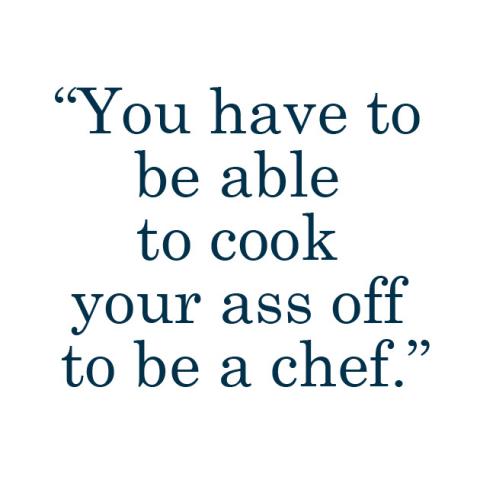
 You have to be able to cook your ass off to be a chef, but just because you can doesn’t mean that you are one. Like most starting out, I was pretty average when I started working in the kitchen, and over time I got better to the point where I got to be pretty good, and now I’d call myself a great cook… and a chef. Notice, how becoming a chef doesn’t graduate you from being a cook, instead, it compliments it and is part of the repertoire.