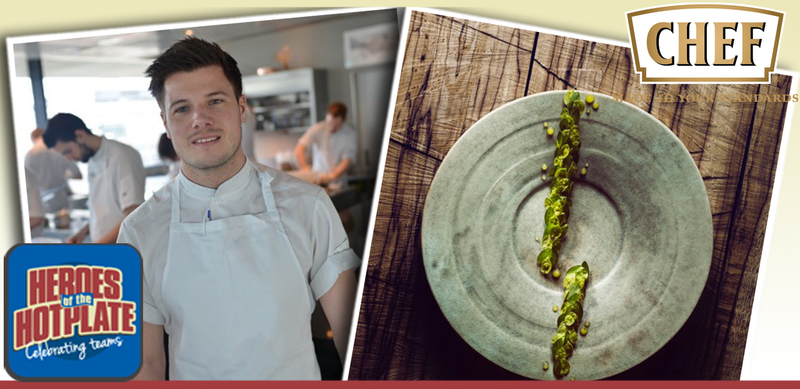
Jordan Bailey is the head chef at three Michelin-starred Maaemo in Norway. He has worked with several top UK chefs starting his career with Phil Thomas at Roswarne Manor before joining Simon Hulstone.
After three years grounding in the industry at The Elephant with Simon, Jordan then went on to work with Sat Bains. It was from Restaurant Sat Bains that he then moved to Norway and took on the role of chef de partie at Maaemo. This year it received its third star and now working as Esben Holmboe Bang’s head chef, Jordan talks to The Staff Canteen about his current role, why he was so intrigued by culinary competitions and why he wants to open his own restaurant in his home county of Cornwall.
 Was being a chef always the plan?
No, there’s only one chef in the family and that’s my uncle, so he was the only vision I had into this industry. I started going down the line of training to be an architect but I did a short apprenticeship and I hated it, being stuck in an office, I got very bored! I was working in the kitchen at a hotel in Cornwall while I was doing my A levels and I fell in love with it. Every time I left the kitchen I just wanted to get back in there.
You were at college when you were offered a job at The Elephant with Simon Hulstone, why did you choose that over finishing college?
It was an amazing experience and going into the kitchen I knew Simon was a competition chef. And I wanted to go in there and steal his knowledge because I found it really interesting. No one in Cornwall really did anything like that.
What was it that attracted you to competitions?
Like I said, there was nothing like that in Cornwall, so it was the mystery of it. Obviously being a chef I like the pressure, I feel like I learn a lot more. After I did a couple with Simon, with his guidance, it really betters you as a chef – just in everyday practices, like working clean and tidy, getting everything up on time, you learn a broader aspect of the kitchen because you are not just doing the one section. Also, using ingredients you don’t normally use in that restaurant at that time – being by the sea we didn’t do a huge amount of meat protein so it was good to get in rabbits and hare.
I did South West Chef of the Year, Craft Guild of Chefs Graduate Awards, I helped Simon in the Bocuse d’Or in the European qualification and the world final. I also went to the culinary Olympics with him.
Did one stand out to you?
The biggest one was obviously Bocuse d’Or, just the panel of judges is second to none and with Paul Bocuse’s name behind it, it’s just massive. If you win that competition or even get into that competition, it kind of changes your life.
As well as learning about competitions, did you take away a lot from working with Simon?
Yeah, I got a solid grounding there which gave me the platform to take that next step up. We also started to run our own farm there, so it gave me an insight into that, it was amazing and I’ve not really had that chance since then. It was really hands on and you appreciate where all your stuff comes from. Being in the South West you are surrounded by incredible products, definitely now I appreciate it makes a huge difference, the places I’ve seen around the world that don’t have that luxury, you appreciate what you have around you.
From The Elephant you went to work with Sat Bains, how was that?
I went for a two day trial and I had to put up three dishes using just what was in the fridge, within an hour and a half! I found out later they don’t normally do that, but it went well, it was a big pressure having all the chefs in the kitchen taste your food.
I was there for two years, it was the next step up again which was what I wanted. One thing I always look for when I go to a restaurant is that the chef whose name is above the door, is working there on the pass. That’s my one big rule, so I can officially say I trained under Sat Bains or Simon Hulstone.
Working at Sat’s was incredible, the attention to detail, in every aspect – it was very military like in a good sense and I like that. I can’t work in a dirty kitchen, with no organisation – I can’t focus. I took a lot from that side of things.
Sat himself is obviously self-taught, so he doesn’t have too many influences, I think that’s where he gets his own style form and I think he really passes this on to the chefs who work for him. So, how to look at ingredients you see every day and use them in a completely different way.
 You were looking to go abroad after Sat’s, how did your move to Maaemo happen?
I sent out my CV to about 12 places, initially just looking for a stage as we had an extra weeks holiday, I got an email back from Esben directly saying he knew I was looking for a stage but ‘if your CV isn’t bullshit, we’d love to have you here’. That’s Esben through and through.
I decided to just go for it, what did I have to lose?
You’ve been there a year now, what has that been like?
The last 12 months have been an absolute rollercoaster. I started on pastry and quickly moved around the kitchen. I was promoted to sous chef after four months, now it’s Esben, then me and we have five chef de parties and around 10 stagiers – I’m responsible for them all.
You didn’t meet Esben until