Dear Chefs,
They won’t understand you. They won’t. I know this, because I used to be on their side, stuck in a dead end office, working a shitty job, making decent pay.
My family and friends were convinced I’d lost my mind when I gleefully leaped into the unknown abyss of cooking. I suppose they thought it was a phase I’d soon grow out of. Could this be you? Maybe finishing high school and are contemplating a life in the kitchen, or already in culinary school. Maybe its not you, but rather someone close to you. Whatever the circumstances, if you’ve gotten this far, I implore you to keep reading.

Chefs are a rare, often misunderstood breed and if you’re among the naysayers, I don’t blame you, I really don’t. However if the smallest piece of you is debating a life in the kitchen, or have already taken that plunge finding yourself needing reassurance, you might find that here. There’s also plenty of ample evidence to scare you away. It just depends on the way your mind works.
Most will never know what it’s like to make a living as a professional cook or chef, and that makes me smile. It’s something of which I am arrogantly proud. No, not because I think we’re better than anyone, but because of the fact that, to be a really good cook or chef, it takes tremendous physical, mental and emotional fortitude.
Most people don’t have, nor appreciate the gifts we’ve been given, and this often includes our front the house counterparts.
Seven days a week, we show up willing to get our asses kicked. We sign up for this in exchange for an opportunity to express ourselves through food. There’s no such thing as weekends or holidays. We might get a random Tuesday off, and if we’ve put in the proper dues and happen to be in cahoots with the chef, we just might have the good fortune of being exonerated from working the dreaded Sunday morning brunch shift.
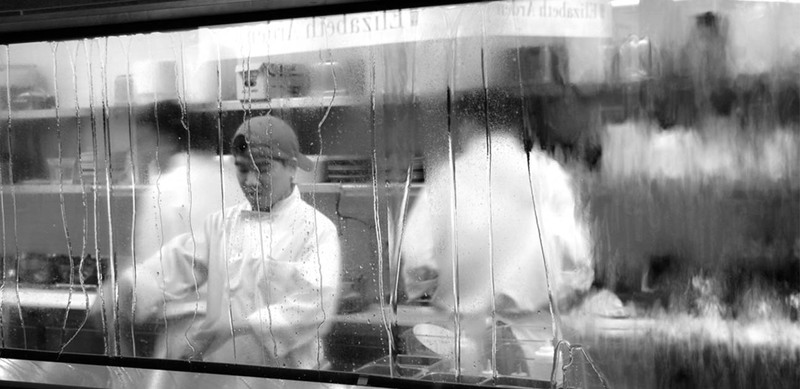
We work longer days than just about anyone. Days start early and end late, typically when the rest of the western world is changing into their PJs, brushing their teeth and hopping into bed. The length, isn’t the hard part though, its the depth. Fifteen hours on your feet is grueling enough to scare away some fence-straddlers, but on top of that, consider the kitchen atmosphere where everything is either excruciatingly hot or sharp as hell.

Cooks scurry around cussing, the printer spewing out tickets as fast as it can, and for hours every inch of one’s body is physically tested. Emotions are tested, and sometimes you will fail that test.
You’ll break into frustration mid-shift, relying on a teammate to help pull you through. Your mental strength will be tested, misreading tickets, overcooking steaks, undercooking pasta, or completely blanking the fuck out on any number of things, once again having to rely on a teammate to pull you through. You’ll do the same for him, it’s how we survive.
Close call finger-nicks and tears shed while chopping onions don’t phase us, not even secondarily. Screaming hot 50 pound pots of salted water simmer away, not boiling fast enough most of the time. When the potatoes or pasta are ready to come out, chances are a dry towel is nowhere to be found, and lacking time to search, we somehow make do, most likely further searing the callouses up and down our already damaged hands. Pain is an after thought, it doesn’t phase us. It can’t, or the whole ship sinks. We owe it to the warriors next to us to keep going.
There will also be a point mid-shift, when you’ll have to make a dash to the dry storage pantry, or the walk-in cooler. Darting across the obstacle course of the kitchen typically includes maintaining one’s sense of balance while leaping across oil-slicked tile, dodging pans flying in the vicinity of the dish pit, and having to weave in and out of fellow line cooks, then back into our place on the line.
This is all to be done without dropping your supplies, or worse, disrupting the rhythm of the team. Disrupt the rhythm, and we all go down with you. This takes serious skills. To create the rhythm necessary for success on the kitchen line takes hours and sometimes years working together as a unit, in the trenches, slugging it out, together. Next to the military in full fledged combat, a group of guys and gals in the kitchen know teamwork better than anyone.
Let’s say you made it to the end of the service. By now several hours have elapsed since the first tickets came chirping through the printer, and the apron draped around your neck now resembles something your dog might have chewed to hell after having splashed through the mud.

You are filthy, but pots are done flying across the kitchen, flames from


 Perhaps now they might understand why every square inch of your body hurts most of the time, and how there really are no sick days in restaurants. They might understand why we settle for grossly underpaid wages, and hopefully they can read between the lines, and figure out why we bitch about customers upon getting off of work.
They might understand how the stress from our jobs might lead us to have a few cocktails, which might be followed with a few bad decisions. Above all, if nothing else, maybe they will see that we can’t imagine our lives any other way.
I’ll take a hand full of burn blisters, some achy knees and the hankering for a drink at the end of the night, over ever having to sit at another desk miserably debating whether or not to shove needles through my eye balls.
Living this life means we get to be creative. It means we get to showcase our skills. It means we get to be creative and stand proud for something we believe in. We get to sleep with a certain piece of mind and awaken the following morning hungry for more. Even if it means suiting up for brunch every now again, we get to make a difference in the lives of people around us, in the best way we know how. We get to make them happy, and we get to through food.
Promise me this:
Show up every day looking to make the most of it. Learn from the best, seek to be the best, and once you are on your way, teach others to be the best. This life won’t be easy. It will be damn hard, but it will be worth it, and in the end you will have lived a life of which you are proud, one that’s yours, and in doing so, you get to make the world taste a bit better in the process.
Cook Your Ass Off,
Chef Chris Hill
Perhaps now they might understand why every square inch of your body hurts most of the time, and how there really are no sick days in restaurants. They might understand why we settle for grossly underpaid wages, and hopefully they can read between the lines, and figure out why we bitch about customers upon getting off of work.
They might understand how the stress from our jobs might lead us to have a few cocktails, which might be followed with a few bad decisions. Above all, if nothing else, maybe they will see that we can’t imagine our lives any other way.
I’ll take a hand full of burn blisters, some achy knees and the hankering for a drink at the end of the night, over ever having to sit at another desk miserably debating whether or not to shove needles through my eye balls.
Living this life means we get to be creative. It means we get to showcase our skills. It means we get to be creative and stand proud for something we believe in. We get to sleep with a certain piece of mind and awaken the following morning hungry for more. Even if it means suiting up for brunch every now again, we get to make a difference in the lives of people around us, in the best way we know how. We get to make them happy, and we get to through food.
Promise me this:
Show up every day looking to make the most of it. Learn from the best, seek to be the best, and once you are on your way, teach others to be the best. This life won’t be easy. It will be damn hard, but it will be worth it, and in the end you will have lived a life of which you are proud, one that’s yours, and in doing so, you get to make the world taste a bit better in the process.
Cook Your Ass Off,
Chef Chris Hill
 Chef Chris Hill left a job in the business world to follow his heart and passion into the world of cooking and the kitchen. Chris opened his first restaurant at 28 and grew into the role of executive chef.
Having taken his experiences in the corporate world, as well as those in the kitchen, Chris has built a large social media following centered around TV appearances all over the Southeast U.S., his writing, TEDx talks, and his mission of helping industry workers to lead fulfilling, successful careers.
Chris' first book comes out in the Summer of 2016 and is a dive into what makes for a successful career in the restaurant world, and includes exclusive interviews with some of the world's leading and most respected chefs.
You can follow Chris on
Chef Chris Hill left a job in the business world to follow his heart and passion into the world of cooking and the kitchen. Chris opened his first restaurant at 28 and grew into the role of executive chef.
Having taken his experiences in the corporate world, as well as those in the kitchen, Chris has built a large social media following centered around TV appearances all over the Southeast U.S., his writing, TEDx talks, and his mission of helping industry workers to lead fulfilling, successful careers.
Chris' first book comes out in the Summer of 2016 and is a dive into what makes for a successful career in the restaurant world, and includes exclusive interviews with some of the world's leading and most respected chefs.
You can follow Chris on