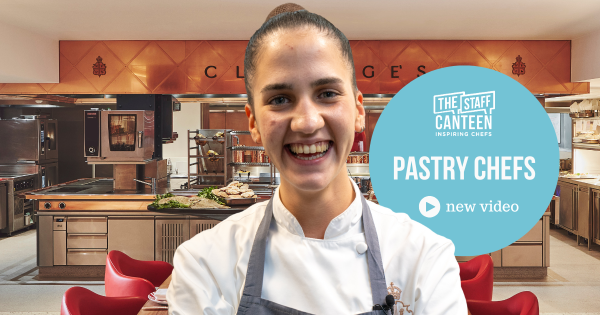
The Staff Canteen speak to the Craft Guild of Chef's Pastry Chef of the Year 2012 and executive pastry chef at The Langham Hotel, Cherish Finden.
Please can you describe a typical working day for you at The Langham?
I’m quite a hands-on chef. Of course, checking is very important – my first job in the  morning is to walk around and make sure the operations of my kitchens are running smoothly, then paperwork; I’ll be working in the kitchens for the rest of the day. I’m a one-to-one chef and I work closely with my staff; the technique of production is very important. The quality that we send out demands attention: every piece of patisserie is checked before I send it to our guests.
How many kitchens and pastry chefs do you look after?
I have two kitchens: one kitchen is for production and I have a second smaller kitchen, which is for chocolate and garnish. I have ten chefs working for me; we supply to the Palm Court, the amenities, the room service, the bar, banqueting and the Palm Court afternoon tea, which takes most of our time.
Why do you feel patisserie is such a specialised area and why are there so few good pastry chefs?
I think it’s a lot of hard work in the pastry section. A lot of chefs produce what they have to do as a daily routine, but for me the technique of making, understanding the process, the science behind it all is so important. Why does the cake rise? Is it the gluten? Is it the water? Why do you add salt into bread? Every ingredient in the recipe is very important to me: why, how? Even using gelatine – silver, gold, bronze: what are the differences?
 How does it affect the recipe? What is the PH? If it changes the PH will it set? Why doesn’t your jelly set? Have you added something that changed the PH? Whenever I do something, I make sure my chefs understand what’s happening. When you make a meringue, you denature the egg whites first: why do you do that? Is it best to whisk the egg whites fast? Does it make a difference if you whisk them slowly? I ask my chefs and myself all of these questions. It’s important for me to pass this knowledge on to my chefs.
In the main kitchen we’ve seen the introduction of a lot of new, modern preparation and cooking techniques: centrifuge, rotary evaporators, water baths and so on. Have you seen these techniques and cooking methods crossing over into the pastry section?
Yes, we use sous vide, particularly during service, but it depends on what I am using it for. I
think maintaining the taste, the colour of the produce – as much as I can, closest to the pure flavour as I can – is important. I don’t like to push a flavour too much in a dish that doesn’t represent the pure flavour. The ingredient has to have the same taste on the plate as it does in nature.
What do you think is the biggest challenge for pastry chefs?
I think there are a lot of challenges for pastry chefs. It’s a lot of hard work in our section. I work 16-17 hours a day; sometimes it’s midnight and I’m still in my whites and I might miss my last train home. The work that has to be put in, I think, will put off younger generations of pastry chefs coming through. How much work does someone want to put into the main  kitchen to progress in the pastry section? For me, I have to know and understand what is happening in the main kitchen to make sure my pastry section runs efficiently. Not all pastry chefs are willing to step into the main kitchen to gather this understanding and knowledge that will help them and make their section better.
Thirdly, understanding the basic principles of pastry: the structures, textures and flavours. How many people will sit on the computer until 5am so they understand, so they can explain to the younger generations why something is happening. As a pastry chef you constantly have to question yourself: why are you doing this? Why is that happening? Finally, breaking the boundaries of traditional French patisserie. I do not like to copy. I’m always thinking about the next collection: the creative side of the next collection. There are great patisserie magazines, like So Good, but you can see people are copying from one another. We have to ask ourselves how we can break these boundaries and present what we do to make it recognisable as the work of a particular chef. I want people to know what I’m doing here at The Langham, for the afternoon tea in


 job. You will be working a minimum of 16 hours a day. It won’t be easy, but if you stay with me, work from today – with me – for one year then you will come out of here a different chef in terms of speed, in terms of knowledge, presentation, skill and personality. As a chef, I think attitude is very important: if you have a very good attitude, I can train you to be a good chef. If your attitude is wrong, I won’t be able to train you – I can’t nurture you in my kitchen. I work hard to motivate my staff: I’ve sent my staff to France for extra training, for example. I will always support my chefs and help them with further training.
 my sous chef position. I believe if you prove yourself and you work hard then you will reach the top in no time; a year and a half is nothing in the scale of your career. I know I can prove myself, so I’m not worried about making a step back to move forwards.