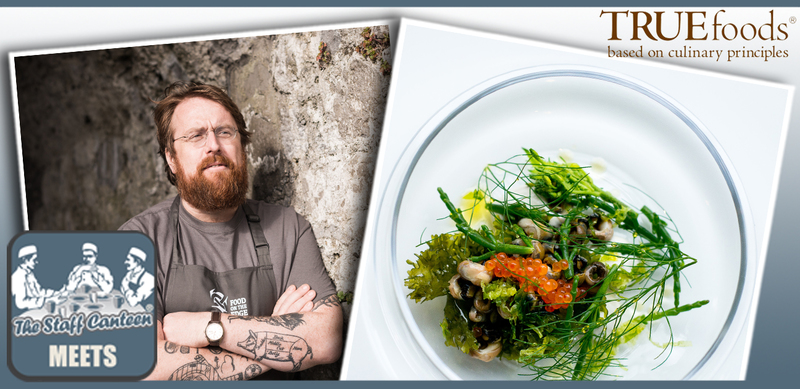
JP McMahon is a self-taught chef from Dublin. He owns three restaurants in Galway, Eat @Massimo, Bodega Cava and Aniar which has a Michelin star. JP has a degree in Art History and English but he chose to pursue a career as a chef when the opportunity to open Cava came up in 2008.
Last year he launched the first Food On The Edge, a symposium for chefs, foodies and those in the hospitality industry to come together and listen to some of the world’s most renowned and interesting chefs talk about a dedicated topic. He had over 40 chefs speaking at last year’s event, including Elena Arzak, Davide Scabin and Clare Smyth and this year is set to be even bigger with Massimo Bottura and Michael O’Hare already confirmed.
We spoke to JP about the Irish food scene, why nurturing young chefs is so important and why he set himself the challenge of bringing together over 40 chefs for Food On The Edge.
 You went to university and got a degree in Art History and English so how did you end up being a chef?
I started cooking when I was 15 but then in my late teens I went back to college as a mature student. I continued to cook because I enjoyed it and I liked food, then the opportunity to open a restaurant came up in 2008 and I decided to go for it.
You’re self-taught, has that been difficult?
I’ve learned a lot from working in different places and I’m quite bookish so I taught myself a lot through various books. Even though I teach people now as well I always feel that I have more to learn.
Over the years since we opened the restaurant I’ve gone to more and more prestigious kitchens to do stages. I spent time with Albert Adria at Tickets, I was recently with Clare Smyth at Restaurant Gordon Ramsay – I suppose I like to put myself in positions that are difficult because I find it rewarding.
Is it difficult to adjust to a three star kitchen?
I don’t find the cooking changes in terms of the basics, it’s just the complexity of the offering. Clare has 18 chefs in the kitchen we have five in Aniar, they have 50 staff in the restaurant and we have 40 something in all three of ours. It gives me a good insight, not so much into the food side of things but definitely into how to run a restaurant. That’s something I’m always trying to develop, that’s what I’m most interested in, the restaurant as a whole rather than just from the perspective of the kitchen. I suppose that has evolved from being a restaurant owner.
You’re not the only one in your family who is in the industry are you?
I’m the only chef but my three brothers all do front of house, it’s bizarre I don’t know how we all ended up in the catering industry! Two of my brothers were restaurant managers at our restaurants, they helped a lot in terms of logistics in front of house. The service side of things I’ve always thought was under looked from a chef’s perspective so I’ve always tried to keep that in mind.
Top five restaurant meals
1. St. John's, London
2. Amass, Copenhagen
3. Chapter One, Dublin
4. Tickets, Spain
5. Ox, Belfast
Five most influential chefs in career
1. Albert Adria
2. Rene Redzepi
3. Ben Shewry
4. David Kinch
5. Ross Lewis
Top 5 comfort foods
1. Pasta
2. Leg of Lamb
3. Risotto
4. Ice-cream
5. Brown soda bread and butter
And what is it like working with family?
It’s a bit difficult! My sister is also our graphic designer and she’s my PA now as well, so I suppose you spend half your life trying to get away from your family and then the other half you are back with them!
You have three restaurants, you opened Cava first, did you have a plan of what you wanted to achieve with it?
I wanted to do a tapas restaurant, I thought tapas was underrepresented in Ireland so we spent some time in Spain, London, New York and we ate in a lot of tapas restaurants top put together an idea of what I would like a tapas restaurant to be. I’ve always had a strong focus on Irish products so I wanted to put them at the forefront, it’s always a mix of a sense of Irishness, staying true to locality but then tapping into style.
I wanted something informal where people would share, it’s still our busiest restaurant and it keeps Aniar going sometimes. As a Michelin-starred restaurant the market for that is so much more difficult in the west of Ireland.
There are just two starred restaurants in Galway, is it hard to bring in the diners?
It is difficult. We have a very good tourist season but in the winter it’s fairly harsh – I mean we have one person booked in tonight. We can only do 36 covers as we have a tasting menu that can go up to 12 courses if people want it so, most people have the table for the night. We don’t set out to turn tables, it’s just a very different model to Cava
We never expected to get a star, I think when we set out we hoped we would get a bib gourmand and we wanted to focus on the produce of the west of Ireland, tap into a lot of wild food and work with local producers. The star was like an avalanche hitting the restaurant, it came out of the blue.
For the year after that the restaurant was full every night of the week, it was the first star in the west of Ireland in ten years, so there was a lot of interest and it was hard to cope with that! The difficulty was and still is, maintaining it. It never seems to go away the nervousness, you do what you do and you think you do it right but every year you start all over again.
 Do you find you focus more on Aniar because of that?
It’s like the final day every day at Aniar, in Cava it’s much more relaxed and you don’t have to worry so much. The food is still the centre, and all three restaurants use the same produce, I wanted to show people that good food doesn’t just come from fine dining restaurants. People will say you can only use those products when customers are expecting to pay premium price, but we take a hit on our own GP and what we make because we think it’s worthwhile. The more places that do it, the better our food culture will