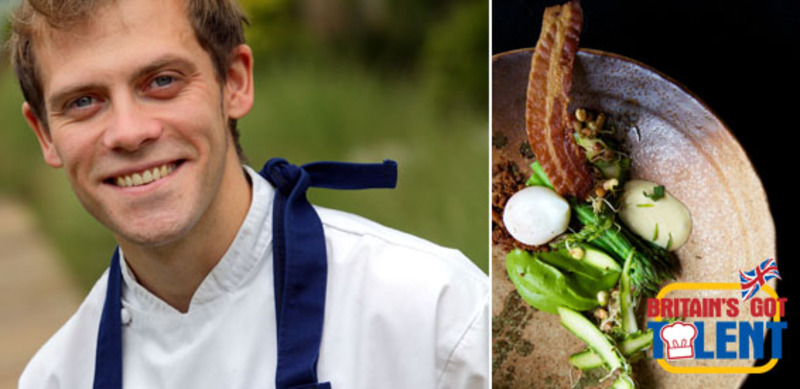
Dave Watts, head chef of Cotswold House Hotel and Spa restaurant, was originally trained by Raymond Blanc, for eight years, at Le Manoir aux Quat’Saisons. Having been senior sous at Le Manoir, Dave became a head chef in 2009 when he was approached to take over the kitchen of Wales’ Hurst House. He then moved to the country hotel, Cotswold House, in 2011.
His cooking is both influenced by Raymond Blanc and his grandmother, who he made jams with as a child. Dave’s ‘rustic neat’ dishes reflect his interest in Japanese cuisine and its natural quality. An example of this is his smoked eel, roasted beetroot, horseradish and oat and lemon sole with pearl barley and lemon.
His dishes also reflect seasonal, simple and sustainable food. Typical dishes include English asparagus with slow-cooked pheasant egg and smoked bacon crumbs, squab pigeon with beetroot, shallots and quinoa and Cornish turbot with peas, broad beans and brown shrimp butter. The food is modern and British but nothing is overcomplicated. He allows the ingredients to speak for themselves through the natural shapes, textures and flavours.
Dave Watts, Head Chef, Cotswold House, firstly thank you for seeing me, can you tell me how long have you been in your current role?
About nine months, I started last year August 2011.
 And are you enjoying it?
It’s great, lots of challenges, lots of ups and downs but we’re moving forward in small steps. We have two new restaurants open, The Grill and The Dining Room and we're getting really good feedback and good consistent business.
It took a little bit of time when we opened the grill in January, it was not the best time to actually change restaurants around but we just needed to get it done.
And what are the long term goals for the restaurant, the business and yourself?
I think the goals for the business are to make today’s Cotswold House more successful than when Ian and Christine Taylor had it originally which is a huge challenge. It’s definitely the vision of Haydn Fentum and Robin Sheppard. Equally, to concentrate on the food and to offer great quality products to our guests that we can source in and around Chipping Campden.
And how would you describe your food style? What are you trying to achieve with the food in both outlets?

Well grill is…I mean we call it a grill because it is a steakhouse but I don’t want to call it a steakhouse. I want it to be known as a grill, British, and that's the point of it. It’s not a brasserie or anything like that, it’s all about British produce and food with really light, simple flavours and just cooked well rather than being too pretentious and difficult. You know, a good local product comes through the backdoor, we do minimal things to it and you get a great product going out to the guest on the table.
Would that be your ethos on the food to use locally sourced, seasonal
Yeah local, seasonal, great textures, great flavours, make sure it’s responsible and sustainable. We have some great local produce and suppliers here.
And what about your cooking style Dave, are you into the scientist’s techniques or the old fashioned way?
I use little bits here and there but I'm not a molecular gastronomist! I use it to aid what we are doing, to give a bit of contrast and textures to certain dishes. My cooking is about the food that we get through the door and what we can do with it and how to elevate it as a food component rather than adding chemicals and trying to turn it into something that it wasn't originally meant to be. It’s all about natural shapes, natural flavours and simplicity. I love Japanese cuisine and I love their ethos so I take that across into my food.
You worked for many years at the world renowned Le Manoir aux Quat'Saisons. How would you say that influenced your career so far?
I think heavily. I spent eight years at the Manoir working with
Gary Jones and Raymond Blanc, some of, without a doubt, the best yea

rs of my life, the most influential, the biggest learning curves that I've ever been through and the biggest ups and downs I've ever had I think but equally it’s something that I was passionate about and driven for to move on within that business, hence why I stayed there so long.
And eight years is a long time to stay.
It is yes it’s almost a double lifetime the amount of hours that you put in but equally it’s always changing and that's the exciting thing about Le Manoir. The change in the food that I saw within those eight years was so different from anywhere else you’d see. That's one of the many positives from Le Manoir, it’s always evolving and moving forwards and that's what food’s about. It’s about learning new things, learning new techniques, seeing different products and using them to your best ability and making the best outstanding food that you can possibly do.
For a young chef, would that be the kind of place that you would advise someone coming 


 enormously. It’s got the two main menus, a menu Classique and it’s got a menu Découverte. The Découverte is a discovery menu that is all about new styles of food and cooking techniques. The Classique is about Raymond Blanc and his classic dishes from the early 1980s, food that he was passionately cooking at that time, cooked today using the same ingredients and recipes.
So going back to learning curves, what would you say was your biggest learning curve, a) as a young chef and b) and now as a head chef?
I think learning curve-wise is make sure you respect the staff that you have; build and respect your suppliers by working together to get the best product that you can. Respect is the biggest thing that you can learn. Nowadays chefs coming into the industry don’t want to do ridiculous hours and get bawled at. Everybody’s different and you need to manage everybody differently. One commis might like to be taught by spending hours one on one where as the next commis might need to be shown once and they bring it.
I think the way you have to manage your staff has certainly changed in the last ten, 20 years from what it used to be…
Yeah.
…whether that’s a reason behind the shortage of chefs in the industry at the moment; I don't know what your thoughts are on that?
enormously. It’s got the two main menus, a menu Classique and it’s got a menu Découverte. The Découverte is a discovery menu that is all about new styles of food and cooking techniques. The Classique is about Raymond Blanc and his classic dishes from the early 1980s, food that he was passionately cooking at that time, cooked today using the same ingredients and recipes.
So going back to learning curves, what would you say was your biggest learning curve, a) as a young chef and b) and now as a head chef?
I think learning curve-wise is make sure you respect the staff that you have; build and respect your suppliers by working together to get the best product that you can. Respect is the biggest thing that you can learn. Nowadays chefs coming into the industry don’t want to do ridiculous hours and get bawled at. Everybody’s different and you need to manage everybody differently. One commis might like to be taught by spending hours one on one where as the next commis might need to be shown once and they bring it.
I think the way you have to manage your staff has certainly changed in the last ten, 20 years from what it used to be…
Yeah.
…whether that’s a reason behind the shortage of chefs in the industry at the moment; I don't know what your thoughts are on that? I think it’s got something to do with it. I think a lot of people don’t want to put the hard graft in but to be at the top in this industry takes really hard graft and a lot of sacrifice. It’s not a simple trade, especially if you’re passionate about it. You need to love it and I think sometimes that's the problem. The youngsters just look for the simple buck and they want to earn money quickly. They think they do two years at a fantastic place as a commis to demi and then they think they’re worth sous chef in the next restaurant rather than actually putting in four or five years graft through commis chef to senior chef de partie.
What would you say has been your greatest success of your career to date?
To be senior sous chef position at Le Manoir where I was running the kitchen underneath Gary Jones five days a week.
What at Cotswold House would be your biggest frustration as a head chef?
Staffing is a big frustration. Planning; not having a correct plan or procedure for what you want to get out of a business. What are the
I think it’s got something to do with it. I think a lot of people don’t want to put the hard graft in but to be at the top in this industry takes really hard graft and a lot of sacrifice. It’s not a simple trade, especially if you’re passionate about it. You need to love it and I think sometimes that's the problem. The youngsters just look for the simple buck and they want to earn money quickly. They think they do two years at a fantastic place as a commis to demi and then they think they’re worth sous chef in the next restaurant rather than actually putting in four or five years graft through commis chef to senior chef de partie.
What would you say has been your greatest success of your career to date?
To be senior sous chef position at Le Manoir where I was running the kitchen underneath Gary Jones five days a week.
What at Cotswold House would be your biggest frustration as a head chef?
Staffing is a big frustration. Planning; not having a correct plan or procedure for what you want to get out of a business. What are the  business goals, how do we achieve them, not as a single person but as a group of managers? I think that's the biggest problem at the moment is just trying to work to that and actually say, “Right, we in three years want to be at this place how do we get there?”
In your role you have to think as a businessman as well as a head chef. You've got to keep your chefs interested. They want accolades, that's why they take certain positions but you have to balance the two
Yes it’s hard.
First and foremost it’s about food for me, running virtually parallel is the business. It’s not about bums on seats, that’s not what I do. It’s about how we can achieve the best profit that we can by being efficient because if you do things efficiently you can earn more profit
Consistency is the key and equally staff. You need to drive staff and keep them interested with change, training and stages and treat them with great respect and you get that back from them and they’ll stay with you for as long as you keep them happy really I suppose.
Where do you see yourself and Cotswold House in five years time?
business goals, how do we achieve them, not as a single person but as a group of managers? I think that's the biggest problem at the moment is just trying to work to that and actually say, “Right, we in three years want to be at this place how do we get there?”
In your role you have to think as a businessman as well as a head chef. You've got to keep your chefs interested. They want accolades, that's why they take certain positions but you have to balance the two
Yes it’s hard.
First and foremost it’s about food for me, running virtually parallel is the business. It’s not about bums on seats, that’s not what I do. It’s about how we can achieve the best profit that we can by being efficient because if you do things efficiently you can earn more profit
Consistency is the key and equally staff. You need to drive staff and keep them interested with change, training and stages and treat them with great respect and you get that back from them and they’ll stay with you for as long as you keep them happy really I suppose.
Where do you see yourself and Cotswold House in five years time? Personally I'd love to have three rosettes and a Michelin star which is a personal goal I suppose. You get what you deserve by producing it consistently, not just having a focus on one single thing.
For Cotswold House I really want it to be the best hotel in the area and to have its name stamped across the UK.
My last question Dave, what advice can you give to young chefs thinking about the industry
Love the food that you produce, taste all the time, ask as many questions as you possibly can because knowledge is power.
Dave Watts head chef of Cotswold House thank you very much for your time.
Personally I'd love to have three rosettes and a Michelin star which is a personal goal I suppose. You get what you deserve by producing it consistently, not just having a focus on one single thing.
For Cotswold House I really want it to be the best hotel in the area and to have its name stamped across the UK.
My last question Dave, what advice can you give to young chefs thinking about the industry
Love the food that you produce, taste all the time, ask as many questions as you possibly can because knowledge is power.
Dave Watts head chef of Cotswold House thank you very much for your time.