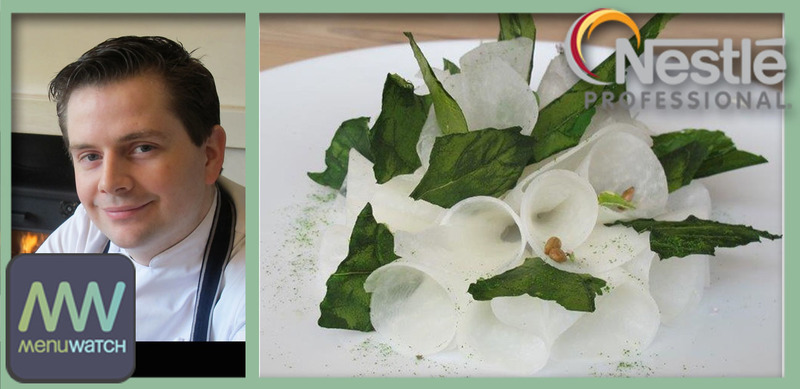
Kenneth Culhane is the head chef at The Dysart in Petersham. A Roux Scholar, he is from Ireland and trained at the Dublin Institute of Technology.
Kenneth has worked in several two and three Michelin starred kitchens, including Restaurant Patrick Guilbaud in Dublin and restaurants in New York, Sydney and France. He has developed his own fresh and distinctive style of cooking which encompasses the very best of British and French ingredients, traditional techniques that rely on classical skills and Asian influences.
The Staff Canteen caught up with Kenneth to find out more about his style of food, his passion for experimenting with unusual ingredients and the produce which is grown especially for the Dysart.
The Dysart and the food style
Tell us about The Dysart and the style of food?
What we are about here is taste and understanding the taste profiles of food and produce and how to put them together in a harmonious way. We have brainstorming evenings where we will try out dishes and it helps the guys to hone in on flavours. I’m fortunate, by choice, that I’ve worked with a few chefs that love the flavours of Asia, subtly used, so I like to experiment with some more exotic ingredients like young ginger, different mints like ginger mint, we have 12-14 different chillies and mara des bois strawberries when they are in season.
The reason I like those strawberries is they remind me of the ones I would have growing up. They are the closest you can get to wild strawberries in a cultivated manner. They are also beautiful with their colour and small form.
Becoming a chef and career to date
You grew up on a farm back in Ireland, has that always influenced your cooking and the need to know where your ingredients come from?
Yes, it definitely had an impact on my getting involved in food. But I didn’t know a lot about food then, it wasn’t until I worked in some good places that I found out about flavours, combinations and things like that. On the farm it was about growing stuff, the back to basics stuff and we always worked in the old traditional ways, which are so important to me because they are best for flavour and best for looking after the land and the future.
What drew you towards the hospitality industry?
 It’s different now, in the past ten years chefs have made it a more appealing industry to be a part of. Back then my family wanted me to go to college and do pharmacy or veterinary studies – I studied science at college in Dublin for two years but it wasn’t for me. I wanted to stay in Dublin so I got a job at the Shelbourne Hotel, for so long an essential feature of Dublin.
You went on to work at Restaurant Patrick Guilbaud while doing a degree in Culinary Arts, did working in a two-Michelin star kitchen change the way you thought about food?
Even going to the Shelbourne was an amazing thing for me because I’d never seen a lot of those things, from patisserie and pastry to making ice cream – it seems like a simple basic thing but when you are young and you’ve never seen it, for me it was a big thing. Guilbaud was so disciplined, organised and real top-end fine dining. It was a big shock, everyone is focused and they are delivering a top-end product. It was exciting though, when you are part of something like that you feel like you are going into a higher league. What makes these restaurants different is the creativity of the chef, the team and I’d never seen group creativity like that. Guilbaud was the initial building block for my wanting to be a part of these restaurants.
From there you worked at Le Choiseul in France, was working in France something you always wanted to do?
I think it’s something most chefs want to do. The reason I wanted to go to France was to develop my understanding of the connection between the producers, working in a city environment yes, you know your suppliers but it’s nothing in comparison to being in a rural location. We’d go to a big market every week and suppliers would tell ‘Maitre Cuisinier de France’, Pascal Bouvier that he had to wait another week until he could have certain ingredients so he was always aware of and certain to get what was at its best. It was very market driven food and I saw things I hadn’t seen before for example making sweet dishes from savoury ingredients.
So, now you’re at The Dysart have you implemented those ideas there?
Yes, and building upon all I have learned and taking it further - with total support. My next step was always going to be to make sure that I work only with the very best produce in season from suppliers I know and have selected personally – some of the best in the UK and France, and try to grow as much of our own produce as possible to get as close as possible to that way of cooking.
We have one grower who is only growing for himself really, he grows in a natural and traditional way because of his love of produce and nature and the excitement of being part of what we are doing. I make sure that our meat only comes from organic farms and that the animals live natural open air lives – which is of course now very much the emerging standard but was not always so until very recently. I unite these with classical ways of preparing food, avoiding all the clever gizmos that are ubiquitous in the top kitchens – I have interviewed senior chefs who have said quite openly that they would not know what to do without these and earnestly suggest to young aspiring chefs that they should learn the key skills before coming to rely on these pieces of equipment which I will not have in my kitchen.
 What products do you use at The Dysart which embrace older techniques?
At the moment we are using Cornue Des Andes tomatoes, they are the original variety of the plum