Ahead of this year’s live launch of the Michelin Guide UK, we spoke to Elizabeth Auerbach, more commonly known as Elizabeth on Food.
As a passionate champion of all things Michelin we thought she would be the ideal candidate to quiz on what to expect from the new guide, who she would like to see receiving new or more stars and whether she thinks there will always be a place for a paper guide in this digital age.
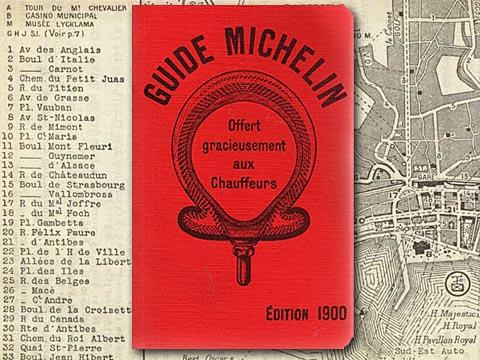 It was 15 years ago when Elizabeth Auerbach first developed an interest in fine dining and she admits she quickly found out that Michelin ‘is a reliable source of information, both for restaurants and for hotels’.
She said: “In my experience Michelin is still the most reliable source in most countries. They probably get it right more than 90% of the time. If they do get it wrong, it’s particularly disappointing in the 2 and 3-star categories.
“In recent years Michelin has made some puzzling decisions in the two-star category, especially in Germany and in the Netherlands. Germany has experienced a Michelin star boom in the past decade and as a result the quality in the two-star category has become very variable. All their three-star restaurants are solid, though.”
On the subject of three stars we are probably not alone in expecting the Fat Duck to regain this enviable status but Elizabeth would also like to see L’Enclume join this elite club too.
“A third star for l’Enclume would be well-deserved,” she explained. “And based on my meal from last June, a second star for The Clove Club wouldn’t be out of place.”
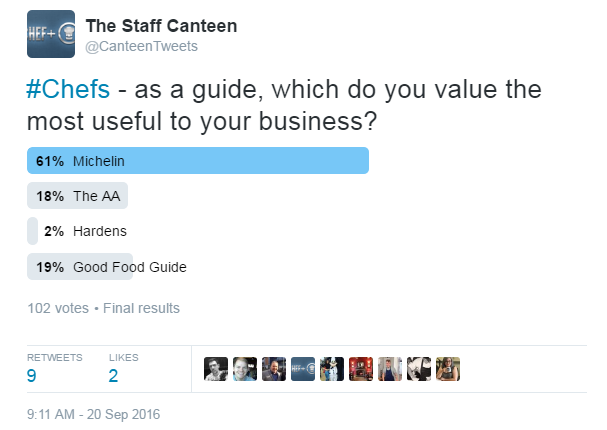
Michelin is still the oracle for chefs and restaurants, it came as no surprise that this was the restaurant guide which topped our own poll about which guide chefs took most notice of. Despite everything now being online, it seems this book has not lost its appeal.
“The combination of Michelin’s independence, generally high standards and its century-long heritage, makes a Michelin star the definitive quality stamp for a restaurant,” said Elizabeth. “It obviously generates business, but perhaps even more importantly for chefs personally, by earning a star they gain the respect of their peers more than by almost any other accolade. Who doesn’t want to follow in Paul Bocuse’s footsteps?”
Elizabeth is an international traveller and well informed due to these travels on the consistency of stars around the world. So, is a one star in France the same as a one star in the UK?
“If you look at the European guides, you see that individual country teams have their own approach. You get the impression that up to two-star level, the teams are pretty autonomous, and they definitely consider local standards and traditions, e.g. the UK team awarding stars to pubs.
“I think Michelin’s 1, 2 and 3 star rating system is struggling to rate today’s incredible variety of restaurants. The star system dates back to a time when there was much less diversity in France and in Europe in general. There are some really good restaurants around that fall in the wide gap between a Bib Gourmand and a Michelin star. I get the impression that Michelin deals with this issue differently in different guides; some are more conservative and cautious than others.”
She added: “An important issue, however, is that all the guides are too slow in withdrawing stars. There are plenty of examples in Europe of restaurants, whose one, two or three star glory days are long gone. Take The Waterside Inn in Bray for example: it’s still a fine restaurant where you can have a good meal, but the three star sparkle is no longer there.”
Asia has seen an influx of Michelin stars, but it’s highly plausible for people to question if this is a reflection of the food or commercially driven.
 “I honestly don’t know. Michael Ellis said in an interview earlier this year about the new Asian and US guides: “We’ve been brought to these cities by governments, tourist boards and local industry. We don’t go anywhere without financial partners”. It makes you wonder how they are able to maintain their independence.”
Despite being online and easily accessible, Michelin remains one of few publications which people still want a printed copy of in their hands and for on their shelves.
The question is, will this always be the case or will it succumb completely to the digital era? Elizabeth says the online presence of Michelin varies per country.
“Michelin used to have a really crappy website,” she explained. “But that has changed a lot in recent years and there is now an app of all the European guides – I use it a lot.
“The UK and France are active on social media, Germany, Italy and the Netherlands are not. Some countries only have a “viamichelin” website, others have special restaurant websites which also feature a blog. Particularly the German website is very useful and interesting, but unfortunately it’s in German only. But in general you have to know where to look, because Michelin isn’t very active in promoting their online presence. This is a missed opportunity.”
It’s obvious Elizabeth has a passion for the Michelin Guide and she still vehemently believes in its credibility. She openly defended the guide against an article by Tom Doorley, last month saying ‘Michelin is not above criticism, but Tom Doorley’s articles do not give


 “Yes, who wouldn’t?”